Friday, October 23, 2009

Downtown Greensboro: The Arts District


Welcome to another exciting edition of my blog journeys! Today, we continue our journey into downtown, but this time, we focus on one special district, the Artistic District. This is the area where the arts hold a main portion of the area. We will begin in the Central Park.
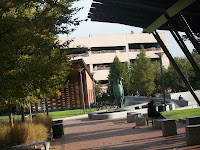


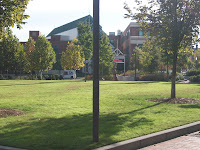
Center City Park is a more recent addition to the city of Greensboro. It is a tribute to the arts through the artistic pieces placed throughout the area. We have, on the right picture, a vase of sorts and a building with bronze plaques of donators (and the restrooms...haha). Now, there's a mystery here. The area where the park is had many buildings there. Why did they need to have this empty space for arts? Well, I believe that the area of downtown was developing so quickly that there was no space around for miles. Kids in the area worried more about work and left behind the aspects of nature and art. The people saw this and thought about saving a spot for those aspects. So, I see this park as a way to restore and uphold the aspects of art and nature.
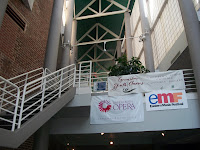
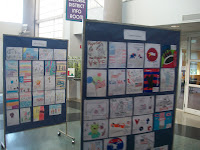

Another area we went to is the Cultural Center. The Cultural Center is actually a cross from the New Library back to the Central Park. Along the way, there are areas where there are offices for the performing arts groups and meeting places. Also, as you can see, there are artistic pieces placed all over the area. Now, this building speaks out to the issues of the lack of art in downtown. The issue is that this is one of the only areas where the arts are openly displayed. The access of the arts are slightly limited because of the areas of businesses around. So, there's no space for artistic designs out in the open. Instead, there's only the "avenue" and the alleyways from last time. So, the Cultural Center is a key stand out to the arts and the lack of space for it.


Next was the Central Library. This library is actually a newer library built by the Historic Museum. The Library is one of the big areas here in downtown. The biggest symbol here is the dome in this picture. This dome symbolizes, what I believe, is open opportunities. The sky is the limit for education and the arts. The hole in the middle, I believe, represents that education and the arts will always poke through the stone of the norm and technical style.


The Historical Museum is a place where the history of Greensboro is shown. It started as a Presbyterian Church, then became a auditorium, a hospital (right picture), and finally a museum. Now, why did they re-use the church to make a museum? My idea is that why build a new building for a museum when you can put history in history? Also, space is another key to the equation. Still, the history is what the area was trying to recover from the trouble of multiplying businesses. History is another of the arts that was fading away and the people wanted to keep despite the growing presence of business.


Finally, we stop by the Old Public Library. This area was the old library, but was closed because of a new school for Elon University, the School of Law. As you can see, there is a atmosphere of quietness and tranquility. The other building has more of an artistic style while this area has more of a bankish style where the normal is there. This area does fit more of the law style and courtrooms. Now, this area seems more of a conference area than a library. The spacing of the rooms are not very huge and it's more of a place of work. The newer library is wide-open and the arts reassure the use of books and imagination. It's a great spot for reading and artistic ability.
In the end, I believe each of the buildings meet the streets in a crazy way each time. The museum has a fence, the Cultural Center has a mini-park with art, and the Library actually meets the street but doesn't blend in with every building. Now, there are little companies around the areas like car dealerships and factories. I believe that these areas symbolize the times where businesses were dominant in the area, but the arts have taken over and businesses have to adapt to this.
Thanks once again for reading! Leave as much feedback as you can!

Wednesday, October 21, 2009

A New Era: Downtown Era


Welcome back to another exciting episode of the Amazing Journeys of HSS 105! Today, we leave the College Hill and College Park area and we go to our new area: Downtown!! This is considered the center of Greensboro itself because this was the road to where the market was. Hence the name of the street that bisects it: Market St. Downtown Greensboro has some great history behind it. Still, what fun would the blog be without Clay's wonderful vocabulary to define the city and its elements? Also, another thing we will look at how the vocabulary changes from an older time to a more modern time.


First, let's begin with our obvious beat. The obvious beat of Downtown is right near the center of downtown. It is the intersection of Elm St. and W. Market St. Many people cross through here because it leads to many different areas like UNCG and A&T State University. It also is a merge point for the 4 districts of downtown, which we will get to later. Therefore, this is the beat of downtown. Now, the beat desn't really change. The definition still is the same, really, but a change I would say is the fact that not only is it a crossing point, it becomes the point where two or more districts meet and form a mutual point.


Next, we have our stack. Our stack is the County Jail. This jail has no more use for the community except to keep the inmates in and away from society. Also, it is a huge stack that might grow taller if the inflow of inmates continues to grow. Side note! Why would the people of Greensboro put a jail in what was once a growing part of Greensboro? Isn't that a safety hazard if an inmate escapes? Well, I believe that this jail was built around the time where people began to live over around Friendly Ave. instead of downtown, so people were not as affected. Also, it could serve as a reminder to people in the business side of downtown that crime will not be tolerated and this is where you will go if you do not follow the law. It becomes a menacing tool to control downtown. Now, a stack has changed from its definition of useless junk. I believe it changes to an area where it will be useful but there's no area to expand except up. Thus, a stack is usually very tall.


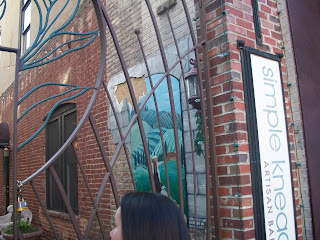
Next, we have our sink. Now, the sinks change into a treasure that is hidden behind the drabs of the city life. My sink is actually multiple parts of the area. It is the art hidden in the alleys of the downtown area. These are hidden treasures placed by the city to revive the artistic values of downtown. They are hidden in areas where they could fins it, like alleys or in a traffic circle. Something like that.


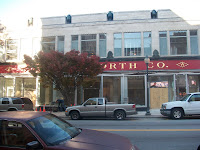
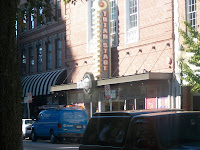
Next, we have our strip. The strip represents the most developed area in an area now. Not exactly a developed area, but the most developed area. My strip is Elm St. Sadly, I did not get the street sign, but I got the developments along Elm St. What you see here is a few general stores and a theater of sorts. You only see a few of them, but there's actually tenfold. There's also a lot of historic aspects to this street. Woolworth's (the bottom picture) was actually where the first Civil Rights Sit-in took place. It was one of the birthplaces of the Civil rights movement. Amazing history on a strip of Downtown!


The districts are numerous in this area. In downtown, we have 4 big districts that resonate from one big merge point. It all begins at our beat, the intersection at the top. On West Market St. which lead to UNCG is the government district. This area consists of Guilford County Courthouse, the city hall, and numerous other government facilities.

On West Market St. going towards A&T University is the more residential and parking district. This area consists of more of the apartments and parking lots. This would be a more popular area for the downtown area. One special area is the big parking lots that decorate the area.

Next, we have to the left of Elm St., our arts and humanities district. This is where the artisitic areas are and even the human rights areas are. It represents our artistic interests and our city's values in art. Presently, this has begun to spread into the other districts, so tis district could get bigger.

Finally, there is the right side of Elm St. This district is called the business-oriented district. We have our strip here. Also, we have our banks, general stores, and even some bakeries too. Through here, you will rarely see an apartment complex or anything like that. This is what I would also call a "money" district.

Finally, we have our fronts. Our fronts are actually two streets that create the boundaries for downtown. First, there is Davie St. Davie St. marks the street that cuts the downtown from the area with A&T University. It serves as a boundary for this area because on one side, you see a lot of businesses and apartment areas. On the other side, you see clearing that soon lead to the university. Interesting, huh? Then, there is Cedar St. Cedar St. spits downtown from Greensboro College. Also, it marks the barrier for the College Hill neighborhood which doesn't look a thing like downtown.

Well, that's it! I hoped you enjoyed my ideas and give me as much feedback as possible. Thanks for listening!!

Friday, October 9, 2009

The Progressive Mansion of Greensboro


Well, here I am again!! This time, we went to a new part of Greensboro, out past McGee St. and onto Blandwood Estate. Blandwood Estate is a place that stands out today and in the past. It was the home of former Governor of North Carolina, John Motley Morehead, and his family. It was a progressive style of house that changed over time, but why did it change so much? Also, a little note to remember is that this mansion was built by James Bland in the 1770s.


Now, why did this place change so much? Well, from its time of being built to its final change, it was meant to impress the masses of guests that came in the building. It stood out so much that even people were scared to go in, but most people still did. Still, Gov. Morehead was a porgressive governor. He saw that his house had to represent what he stood for. Therefore, his house had to change to fit the progressive style. Now, to begin the tour.


Now, this was the ceiling of the first room people saw when they entered the Mansion. Right off the bat, you can see that this is a different ceiling from what you see in a normal house back in the 1800s. It's too nice for any other ceiling. Plus, when you came in, your breath was taken away from the beauty of the room. Once you came in, you would go to one of two parlors if you were a guest. One's the King's Parlor and the othe ris the Queen's Parlor.


Now, the King's Parlor is the one on the left. This area was a parlor for quiet entertainment and good conversation among the Governor and the guests. The furniture is set comfort and there are so many interesting things in this room. The big thing is that there were mirrors on the back of the doors. For what reason, you ask? Well, it was used to reflect light from the big window directly across from it and light up the room. The rooms were still old-age rooms, which meant that they were dark. This could mean that Governor Morehead had guests over even into the still of the night.


On the right, we have the chandelier from the Queen's Parlor. Now, if you can see, there is a crown on the chandelier. It's a little crown of leaves. CONTEXT CLUE!! If there is a crown on the Queen's Parlor's Chandelier, then the King's must have one as well. Indeed. The crown on the King's Chandelier is bigger and more royal-looking. Now, the Queen's Parlor was the entertainment room. There was music (mostly) and more furniture for talking. Now, each of these rooms had the strong decorations and, especially, the ceiling decoration we saw earlier. Why are these rooms so nice? Well, my belief is these rooms were the main areas for guests to be in and the other rooms, like the bedrooms and upstairs rooms, were not.


Now, I'm going to use the kids' room to represent all of the rooms of the Blandwood Mansion. First, these pictures were just a little indication to know that this was the kids' room. There's c cage over the fireplace in the room and there's games for the kids to play. Interesting, huh?

Now, this represents the rooms. Each had the style kind of like this. There's nothing special about it or anything that sticks out. It's a nice rom that is relaxing. This could represent the idea that the people of the house did not expect anyone back here , but kept them in the guest rooms at the front.

Now, the final part of the blog is the big question. Why did they change the house so many times? Well, I believe that the house represents what the state of North Carolina was changing into. It was becoming a progressive state. NC was changing and Morehead knew this. He had to represent what NC was becoming. So, he changed his whole lifestyle to fit change. Plus, he had to impress due to the fact that he had so many guests. So, he changed the house a lot to fit the changing style of North Carolina. Now, you see that this is a great Estate that is esteemed by all of North Carolina.

Tuesday, October 6, 2009

College Park vs. College Hill: What's the Difference?


Well, another day and another blog comes around. This time, we will be looking at the neighborhood College Park and how it compares to College Hill. To begin, we need to know more about College Park to make our comparison more credible. College Park is a neighborhood that is right outside UNCG. It starts at Spring Garden St. and goes around S. Elam St., and of course, Walker Ave. So, here we go!

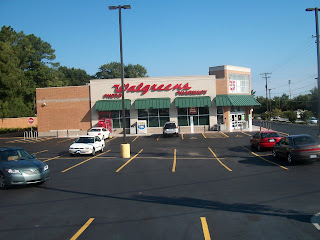
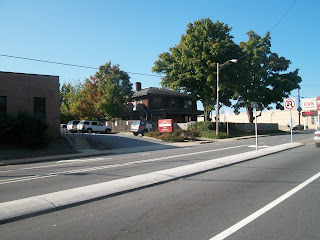
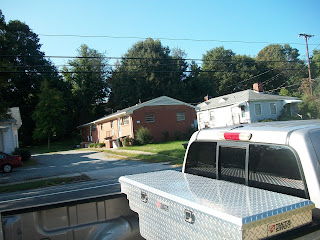
Let's start with Spring Garden St. Spring Garden is the big street for this area because of its location to the university and its developments. As you walk right across campus, it seems to look nice (around Jack's and Walgreens), but as you move further out, the appearance goes downsome (around the apartments). Spring Garden St. is a big street due to the fact that Spring Garden developed very quickly after its construction. You can see that near the university, the area looks quite taken care of (Walgreens, restaurants). We believe that this part of Spring Garden was developed more recently and it is more taken care of due to the fact that it is near a big landmark, UNCG. As you go down the street, you see more of the residential part of Spring Garden St. There are more apartments down this way and some residential areas. This could show that these apartments are used by college students. More likely, these students want a safer environment near the university. As for the residential areas, the areas here are weird though because as you can see from the picture below this one, the buildings do not face the street. It faces the other houses on the street. This could have been a style of the times when Spring Garden was made. They could be infills for lots that had been down this area. All we know is that they are not like College Hill, where the houses face the streets.
Next, we will talk about the residential areas of College Park like S. Elam St., Mayflower St., and even parts of Walker Ave. The College Park neighborhood obviously is a residential area. The homes in do not vary tremendously, although a few styles are seen as you walk the streets. Larger apartment complexes were found along with the average size we have been seeing in recent weeks. On the side streets in the core of the neighborhood we found craftsman style houses, and some more boring looking ones. I would guess they were built in the 1960's because of the boxy feel they have. The houses along Spring Garden St. were situated very close to the road, where the houses farther in the neighborhood had bigger yards in some instances. We noticed more retaining walls in front of houses. We did not ever come to a conclusion to what that signifies exactly, but more houses were above the road. Maybe a value of housing is what is to be learned from the walls. Even though the land was not perfectly convenient for building, the need exceeded that inconvenience. We also noticed a creek that went under the road and did not come out on the other side, I would consider this another sign of the importance of housing for the same reason as the retention walls.


Along with this we noticed that each residential house was pretty big and full of space. They looked more like permanent homes. We believe that these houses on S. Elam St. and the the other small roads are family homes, not the student homes we saw on College Hill. Therefore, we could tell that these buildings were around to add more space for the families of Greensboro at the time. Besides, it was right beside a strong part of campus. It was beside Walker Ave., the first strong street, the Spring Graden St. Before we move on to the next part, just a quick observation we found. We saw that the sidewalks in the back roads were lined with brick as we went on. It was tough to decide what these bricks were for. Were the for looks? Probably not, due to the fact that there's a use for mostly everything in Greensboro. What about a drainage system? It's tough to decide because we found no particular use for the brick beside the siewalks.


Finally, we came to our cut-up street, Walker Ave. Walker Ave. is a street that is used mostly for residential purposes now. We have seen many houses along the way and these are very nice houses as well. We see the bungalow type mostly from this street, so we can see that these houses were filled in for something else. Now, Walker Ave. looks like it used to be a dominant street for this area and the proof is there. Back at the part of Walker Ave. we came on, we saw many developments and old time buildings. For instance, we saw an old bar called The Blind Tiger. This bar was very special due to the fact that we looked at the sign and saw that it had been around since the 1920s. Maybe earlier than that. Also, we saw other developments like Fishbones, Walker Bar, and The Property Source. Also, we saw a ton of infills, but we also saw another piece of evidence. Lots. Lots were all around Walker Ave. whether they were used or not. Something must have been there before and had been taken down for the sake of the infill of houses. Now, we move on and see that two churches had been placed along Walker Ave. These churches looked pretty well kept so the may have been placed in for the houses so no one would have to walk to the churches around College Hill.

Now, the fun part. College Hill turned out to be mostly a residential district for college students and some bachelors and bachelorettes with a job. It had its own strip right beside Tate St. and it was near two of the colleges in Greensboro. It was not developed as well. and you could tell that these buildings were older and more useful towards livng purposes. The only development we saw was around Mendenhall St. and Tate St. There were infills, but not as many as College Park.

College Park, on the other hand, is a more developed area of Greensboro. It has more businesses and restaurants than College Hill. The residential part of the area is more for families than for students, though there were a few areas with student housing. College Park is based around two strong streets, Spring Garden St. and Walker Ave. compared to College Hill. There is more of a contemporary style with this area and it doesn't follow the old style of College Hill. Therer are more bungalows compared to the Queen Anne style houses. There are definitely more infills in this area due to the developments. All in all, this area was developed quickly compared to the historic style of College Hill. So, you can see that College Park is very different from the oder and more historic College Hill.

Wednesday, September 30, 2009

The World Has Come To An End....... They're Allowing Me To Choose What A Old Building Becomes.


Well, all I can say is that I can't believe that they have given me an opportunity that they might soon regret giving me. Just kidding. Today, I become a city planner and I will reuse some of Greensboro's history to make some new buildings that will benefit the city. Also, you will be my voters, my wonderful followers. If you want (and I love having your opinions), give me a yes or a no for each building you believe is possible and reasonable or not. I'll tally the votes and post them on my next blog. It's a little twist to the blog, eh? Well, here goes!


First, we have this warehouse right in the heart of the back of our college neighborhood. This, I believe, was on another stretch of Walker Ave. and it was near Lee St. Now, this building, as you can see, is pretty big and it is in an area near the back roads that connect off of Lee St. As your city planner, I propose that we change this old warehouse into a top of the line police station. This area is just out of the reach of the police station on Tate St. Also, that station is used mainly for UNCG, so the city is left out a little by this. From my observations, there was not a police station in this area for a few miles. This building is just in the right location where it could take care of the back roads and Lee St. itself. Also, it is a big facility. This big facility could hold an office, jail cells, a K-9 unit, and many other theories. I mean, the sky is the limit with this building. Therefore, we should turn this building into a police station.


My next proposal is for this building. This building is a large building that is 2-stories and can hold a ton of people. Also, it is right beside a big and new apartment complex that will hold many college students. Therefore, my next proposal is that this building should be changed into a Recreation Center for the apartment complex and the community that consists of Lee. St and the streets that surround it. My first reason is that many college students live in the apartment complex right by this building. They have heard of the "Freshman 15" and the weight gain from college. UNCG's recreation center and Greensboro College's recreation center are too far away for these students, so they will not go to those centers. With one center here. they just have to go across the street to work out and exercise instead of walking across town in a scary environment or driving and wasting gas. Also, I recommend that UNCG and Greensboro College co-sponsor the center. With this, UNCG and Greensboro College will gain more money from the center and possibly make this building a education area for those out of reach of their recreation centers. It's educational and a safe way to work out and be the best students can be.


My final proposal is for this building. It is near the same apartment complex as the building in my last proposal. It's a smaller building, but it can still be very useful. Therefore, my final proposal is that this building be changed into a post office for the people in this area. With a post office here for the people, once again, distance will never be a problem for anyone who walks in this area. Safety will not be an issue. They could walk to this building with no worries about safety or gas. Also, it is in a central location where anyone can use it. Students who live here can use this instead of going to a post office far away or going to UNCG's post office or Greensboro College's post office. Along with this, it opens up jobs for the people of this area, like mailmen (or women), postal workers, box boys, and much more. Therefore, it is a safe and easy way to make jobs for the people of this area.

Well, there you have it. My proposals are here for your approval. You know the rules. Comment back with a yes or no to signify your belief in these ideas. The choice is yours, ladies and gentlemen. The future of Greensboro itself is in your hands. What will you do?

P.S. Leave feedback. What do I need to work on? Is it well done? Speak now, or forever hold your peace. Thanks everyone!!

Monday, September 28, 2009

College Hill (Clay style)


Well, as you can tell from my blog title this time, I will be comparing the College Hill neighborhood to Clay descriptions like beats and strips. Hopefully, my Kodak Share Program is working today. We'll see. Now, College Hill has had a great history with its ilustrious buildings and its strips and other spots of interest. Now, let's begin, shall we?


We'll start with the beat of College Hill. College Hill has many popular streets. Two that come to mind is West Market St. and Mendenhall St. This is where I believe the beat is for College Hill. Now, West Market is the street for College Hill where they can access downtown easily and go to many places like Friendly Center and other special areas. Mendenhall is the main residential street for College Hill, in my opinion. Mendenhall is the longest street compared to Tate St. and the most houses reside there. I believe through this, we can see that many people cross this intersection especially which allows me to consider this a beat. Now, from what you can see, this street is very clean and the pavement is very, very well done. Keep this in mind when I go on to the other spots in my blog about College Hill.


Now, the next place to talk about is Tate St. Tate St. fits the bill of a strip in my opinion. This strip is the biggest developed area in College Hill. There's shops and restaurants. There's a laundromat and even the security building. Tate St. Tate St. is truly the strip of both UNCg and College Hill.


Now, once again, think of Tate St in a modifed way now. It is cleaned by the streetsweepers. It's renovated by the city for a better use of the community. Even the buildings are reused to further keep the popularity of Tate St. Again, keep this in the back of your head. What will happen next is that I will talk about the stack and sink next. This is where this blog will get interesting.


Let's start with the stack first. I consider this alleyway my stack. It is an alleyway on Walker St. that has been used from time and time again. Now, from before, you remember that a stack is a piece of junk that goes upward. In this case, I call this a man-made horizontal stack. It's horizontal because it does not stack up. It stacks out like a fallen down building. That is what this alleyway reminds me of. It's a fallen building that has been left aside for other streets. Sadly, this cannot amount to anything else because it won't be paved or made safe. It's just piled in the back of the neighbrhood where it can not become anything more useful like Tate St. and West Market St. Now, why does this happen to a very useful, but somewhat unsafe alley? There was nothing to begained from this alley, moneywise. Tate St. had an opportunity to be useful because it was right beside UNCG, which at the time, was rising to fame. The alley, of course, did not have an use. It was not useful to society and its growing desire, so it was left to just die away. The only reason it did not get turned into a set of houses is because the people have found a use for it. This is why I consider this a stack.


Now, onward to the sink. This is the apartment complex placed up in the back of College Hill on McGee St. Now, from what you can see, this place is so amazing looking that how can this be put to the back of the neighborhood? Well, once again, space becomes a key issue. McGee St. was not very useful to the public due to its location away from Tate St. and UNCG. It was poorly taken care of and I thought that it would have been soon turned into something that is not a road anymore. With the apartments added in, I believe that McGee will become a better-known street, but because of its size, sadly, a sink is all that it will be.


Now, the districts are a little tougher. I can split College Hill up into two districts. There is the UNCG district and the outer rim (the forgotten district, figuratively). The college-dependent district would be, for me, from Tate St. to Mendenhall St. Now, there are a few little streets there, but it is mostly filled up by these two streets. With these, this is where the strip, the beat, the front, and even the vantage points are. It's been taken care of a lot better because it is more public and it has more development than the other streets. With this, I can safely say that this is the college-dependent district. Why? Well, this district is right beside UNCG, the big powerhouse for College Hill, and Greensboro College. It has a reason for being developed due to the fact that it is right beside two growing colleges with a reputation. Now, there's also the forgotten district, as I call it. Why? This district composes of most of the little streets. Now, I call this a district with a split called Mendenhall St. The little streets, as you can tell, are not paved as well and itis not as taken care of. There's no development there, but just houses. These houses are very nice, but they are only improved by the patrons. Plus, there is nothing that can be fixed there unless some of the houses are taken down. Now, I don't want that to happen. Plus, to finish the districts off, this district has only two city spots in the districts: the sink and the stack. These are not like the beat and the front, but only seen as junk.


The front of the College Hill district is Spring Garden St. Spring Garden is the cut between the college residential district to the regular family residential district. Also, if you go out past Spring Garden, you will hit parts of downtown which is different from College Hill. The front represents a fall off from one area into another, so this fits perfectly. Also, you can see that it continues down the street to be more developed. There's also more stores and more buildings that have nothing to do with college or anything like that.
Finally, we have my turf. One turf on College Hill is the church on Mendenhall St. More specifically, I would say the fellowship Hall is a turf. The church represents a meeting point for all people whether it be a less fortunate person or a richer person. Also, it is at a big residential area like Mendenhall St. and it is on an intersection of Walker Ave. which leads to Tate St. This gives the college students a place to meet which makes it more of a turf. Therefore, everyone has a way to get there. So, this is my turf.
Well, feel free to put in feedback on your opinions or your critiques. I always enjoy them. I welcome them and await the challenge you send me through these. Thanks for being so curious!

Friday, September 11, 2009

One Value and the Value Behind it

UNCG used to be an university just for women and a university that taught everyone what they needed to know. Sadly, that was all that the women received. Today, we receive something even more than just the facts. We receive nature, athletics, and a diverse campus. Therefore, as pertaining to my title, a big change for UNCG was the emphasis on nature and the other side of the college student. This value is about changing from an emphasis of just technical knowledge to a special knowledge of nature, the arts, and even in keeping in shape.
My first piece of evidence for this claim is Peabody Park. Peabody Park used to be 18 acres of pure forest and a natural reserve. Now, it is a small golf course, a running/walking track, and the Student Recreation Center. What does this mean? It switched from a forest that no one went to and into a special place for athletics, fun, and nature. The leaders of UNCG wanted to make their mark in the university stomping grounds and saw their chance. They saw an opportunity to be unique and did it. Also, they saw a need for nature in their future and knew that if they left it out, then the future generations could lose it. If that happened, then life would be a horrible place. Also, people must have seen that the times were changing. Women could run and do exactly what men were doing. Plus, the integrated campus led to a need for more diverse and open choices. For example, the running path we knew of today was not paved. It was a dirt road that was hard to run on. It was used to be a walking path for the women. Then, men came to the university and wanted to be athletic. Therefore, the running path was paved and many other spots for athletics were put in.
Next, there is the Gatewood Building. The Gatewood Building is the building for Interior Architecture and some arts as well. Now, you ask why this was chosen for the value of arts. Well, the main reason I chose this for the CHANGE TO AN ARTS PROGRAM is the building itself. It was made to be the "jewel" of UNCG. It shone like a jewel when the sun hit it just right. Plus, it was known to be a landmark for the college. So, if it was meant to be a landmark and it's an arts building, then maybe this could be a notion for the change for the arts. Who knows? It could be though.
Now, sadly I have to put a-to be continued- for this post because I will have pictures on as soon as I can. My camera has been acting bad and my Kodakshare program is on the fritz, but I will have them up as soon as I can. Thanks for understanding, everyone!!